Maintenance Guide
CNC Maintenance Cost Guide
Build a preventive maintenance budget from task-level labor, parts, and downtime assumptions instead of reactive repair surprises.
Reviewed: 2026-03-08Source: Reviewed against ISO 230, GB/T 17421, OEM documentation, and shop-floor calculator assumptions.
Direct answer: annual PM budget = labor + parts + consumables + downtime reserve, with machine class and duty cycle setting the right frequency.
Maintenance budget
Preventive Maintenance Cost Worksheet
Budget worksheet for CNC PM labor, parts, consumables, downtime reserve, and reactive-repair exposure.
| Budget line | How to estimate | Typical evidence | Calculator handoff |
|---|---|---|---|
| Labor | Task frequency x labor hours x loaded rate | PM task list and work orders | Maintenance-cost calculator. |
| Parts and consumables | Filters, lubricants, belts, way wipers, coolant, spill supplies | Purchase history or OEM kit quote | Maintenance benchmark table. |
| Service labor | OEM or independent service hours plus travel | Written service quote | Service contract cost guide. |
| Downtime reserve | Planned PM windows plus expected reactive events | Production calendar and outage history | Bottleneck or maintenance-cost model. |
| Major repair reserve | Spindle, ballscrew, linear guide, control and drive risk | Age, hours, alarm history | Maintenance benchmark table. |
| Review cadence | Monthly variance review and annual reset | Actual vs budget report | TCO calculator if lifecycle decision changes. |
Download PM cost worksheet PDF
Export the labor, parts, service, downtime, and repair-reserve worksheet for budget review.
Model Your Maintenance Budget
Our Maintenance Cost Calculator lets you input your fleet, hourly rates, and service intervals to get annual projections.
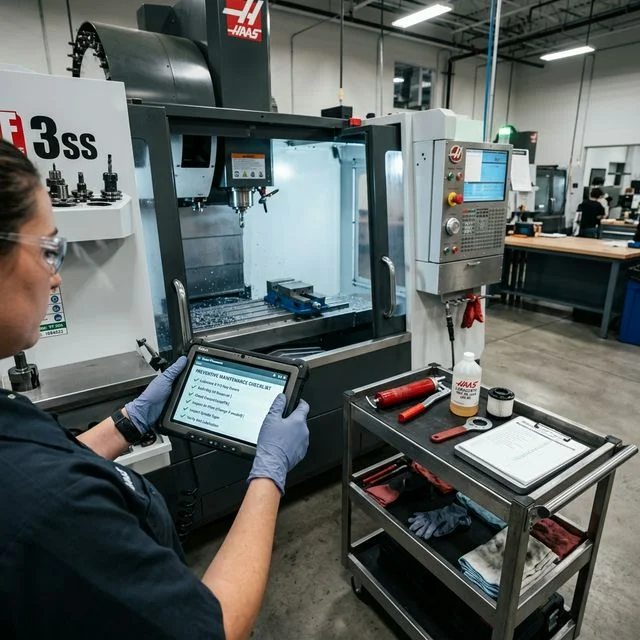
The PM Budget Formula
Flat percentages are not enough for budgeting. A defensible PM budget should come from your actual task list, labor model, parts policy, and planned downtime windows.
Labor Component
- In-house technician labor (loaded rate)
- OEM service labor from written quote
- Independent service labor from written quote
- Travel, dispatch, and overtime adders
Parts & Consumables
- Lubricants and hydraulic fluids
- Air/oil/coolant filters
- Belts, way wipers, and wear components
- Coolant management and disposal
Hidden Costs
- Production downtime during PM
- Diagnostic software subscriptions
- Calibration equipment
- Safety gear / Spill kits
Standard PM Task Frequency & Cost
The table below is an illustrative single-machine template. Replace labor hours, frequencies, and parts prices with your own maintenance records.
| Task | Frequency | Labor (hrs) | Parts Cost | Annual Total |
|---|---|---|---|---|
| Way lube check & fill | Daily | 0.1 | $200 | $1,450 |
| Coolant concentration check | Weekly | 0.25 | $100 | $750 |
| Filter replacement (air/oil) | Monthly | 0.5 | $50 | $900 |
| Spindle runout & bearing check | Quarterly | 2.0 | $0 | $400 |
| Hydraulic oil change | Semi-Annual | 3.0 | $250 | $800 |
| Ball screw backlash check | Annual | 4.0 | $0 | $200 |
| Full coolant system flush | Annual | 6.0 | $800 | $1,100 |
| Geometric accuracy calibration | Annual | 8.0 | $600 | $1,000 |
| Illustrative Annual PM Total (per machine) | Template Output | |||
Example assumes a single 3-axis VMC and in-house maintenance labor. Use this structure as a worksheet, not as a universal benchmark.
Preventive vs Reactive: The Real Numbers
Reactive events usually cost more because emergency labor, expedited logistics, and schedule disruption are stacked on top of repair work. Compare cost structure, not only the invoice total.
| Failure Scenario | Planned Service Cost Elements | Reactive Cost Elements | Downtime Pattern |
|---|---|---|---|
| Spindle bearing replacement | Scheduled labor, planned parts procurement | Emergency labor, expedited parts, potential collateral damage | Planned window vs multi-day disruption risk |
| Ball screw failure | Inspection labor and planned adjustment | Emergency replacement, alignment, production interruption | Short inspection stop vs extended outage |
| Hydraulic system failure | Fluid service, filter replacement, leak inspection | Emergency diagnosis, component replacement, cleanup | Controlled service stop vs uncertain repair duration |
| Coolant contamination crash | Scheduled flush, concentration control, cleaning labor | Scrap, tool damage, urgent flushing and restart checks | Predictable maintenance stop vs unplanned stoppage |
Lost production cost: In downtime analysis, include missed shipment impact, overtime recovery, and premium freight. These indirect costs often exceed the direct repair invoice.
Annual PM Budget by Machine Class
Use machine class to set budgeting logic and review cadence. Do not assume one percentage target fits every platform.
| Machine Class | Primary Cost Drivers | Budgeting Approach | Review Cadence |
|---|---|---|---|
| 3-Axis VMC (newer platform) | Routine consumables, PM labor, warranty boundaries | Task-based baseline with warranty-aware exclusions | Quarterly review |
| 3-Axis VMC (legacy platform) | Wear components, obsolescence risk, intermittent failures | PM baseline plus contingency reserve for major repairs | Monthly review |
| 5-Axis Simultaneous | Calibration depth, complex assemblies, high-value downtime | PM package with metrology and risk-adjusted contingency | Monthly review |
| HMC with Pallet Changer | Pallet mechanism reliability and automation support | Separate base-machine and pallet-system maintenance lines | Monthly review |
| Swiss-Type Lathe | Guide bushing wear, high-duty thermal and lubrication management | Task-frequency budget tied to duty cycle and tolerance class | Quarterly review |
Age Multiplier:
Older platforms often require larger contingency reserves due to wear, obsolescence, and longer parts lead times. Include this risk explicitly when evaluating Total Cost of Ownership for repair-vs-replace decisions.
Maintenance Cost Calculator
Build a custom PM budget.
Predictive Maintenance ROI
Vibration monitoring economics.
Cost Benchmarks Table
Component repair pricing data.
Frequently Asked Questions
What should be included in a CNC maintenance budget?
Include labor, parts, consumables, calibration, and planned downtime. The right budget starts from task history and parts policy, not a single percentage rule.
How often should preventive maintenance be scheduled?
Daily, weekly, monthly, quarterly, and annual tasks should be split by machine class and duty cycle. Heavy-duty or high-speed machines usually need tighter review cadence.
Why does reactive maintenance cost more?
Reactive work adds emergency labor, expedited parts, schedule disruption, and often secondary damage. The hidden cost is usually downtime, not the invoice itself.
When should I compare repair vs replace?
Compare when age, obsolescence, and lead-time risk start pushing contingency reserves higher than the value of keeping the machine in service. Use total cost of ownership, not repair cost alone.